Game Companies logo
GameCompanies.com
Powered by GC Insider
IndustriesJobsGames
GC Insider
All gamesuniversesplatformsenginesDevelopmentPublishingGames by year

Something missing or incorrect? Suggest an edit.

GC

  • Industries
  • Jobs
  • Games
  • Map
  • Insider

Info

  • Home
  • Presskit
  • Sitemap

Social

  • Twitter iconTwitter
  • LinkedIn iconLinkedIn
  • Instagram iconInstagram
  • Facebook iconFacebook

Contact

  • GC Advertise
  • Partner with GC
  • Submit your story
  • Suggest an edit
  • E-mail

Policies

  • Terms of service
  • Privacy policy
  • Copyright policy
  • Image policy
  • Cookie policy
Game Companies logo
GameCompanies.com

Powered by GC Insider

© 2025 GameCompanies.com
Profile picture of Hatsune Miku And Future Stars Project Mirai


  • Platforms

    Modes

    Player perspectives

    Engines

      View more in GC Insider


    All website links

    All in-game images

    All release dates

    Game videos

    Suggest an edit

    Plus much more
    Makers

    Profile picture of Hatsune Miku and Future Stars: Project Mirai

    Hatsune Miku and Future Stars: Project Mirai

  • First released on 8 March, 2012 for Nintendo 3DS
  • Music

    Part of the

    Hatsune Miku, Project DIVA & VOCALOID

    game universes.

  • First released on 8 March, 2012 for Nintendo 3DS

  • Game image #1 of Hatsune Miku and Future Stars: Project Mirai
    Game image #2 of Hatsune Miku and Future Stars: Project Mirai
    Game image #3 of Hatsune Miku and Future Stars: Project Mirai

    About

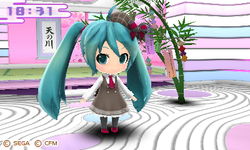
    Hatsune Miku and Future Stars: Project Mirai is a rhythm game and a spin-off of the Hatsune Miku: Project DIVA series of Vocaloid rhythm games. Like the original the game primarily makes use of Vocaloids, a series of singing synthesizer software, and the songs created using these vocaloids most notably the virtual-diva Vocaloid Hatsune Miku. The game features different character designs than the main games and the characters appear as their Nendoroid-style, Super deformed versions. For the game's primary gameplay, its music mode, it uses what it calls the "Chance Circle System". Buttons will appear around the border of a circle, and a pointer will appear from the center of the circle extending all the way outside the circle's border. It will then turn in a clockwise or counter-clockwise manner according to the song and when the pointer passes the button, the player has to press the face button on the 3DS. Similar to the series, the player's time accuracy will also be rated on a similar scale and manner that will be displayed on the bottom of the screen. In addition the game does not feature the Edit Mode of the Project DIVA series, while the DIVA Room Mode is replaced by the game's My Room mode whereby players similarly get to interact with their modules in a room.

    Platforms

    Nintendo 3DS

    Modes

    Single-player

    Player perspectives

    Third person

    Engines

    Not available

      View more in GC Insider


    All website links

    All in-game images

    All release dates

    Game videos

    Suggest an edit

    Plus much more

    Makers

    Image of Sega
    Sega
    Entertaining the world with creative, innovative experiences, one community at a time.
    Developer
    Publisher